采出水已经成为当前油气开采中降本的主要关注点之一,本文将带来一种釜底抽薪式的方法!
编译 | TOM 惊蛰
产出水是指在油气生产期间被带到地面的天然水,采出水是迄今为止油气行业产量最大的副产品。虽然已建油气产区的地层水产量存在显著差异,但据估计,每采出一桶石油,将采出4至10桶地层水。
地层水通常含有盐、细菌、有机化学物质以及其他污染物。虽然一些公司会将地层水用于水力压裂或农业生产,但这并不总是一种经济的选择。大部分地层水的处理方式还是简单粗暴,直接被注入地下废水处理井。
据估计,到2018年,美国油气上游行业将在水资源管理方面投入347亿美元。存储、转移、运输、处理处置地层水的物流网络复杂,占了水管理成本的89%。在单口井的使用寿命中,地层水的成本总计可达600万美元,相当于一口井运营成本的一半。这些费用预计还会增加。
地层水的处理与处置仍是油气行业的重要课题,但从源头解决这一问题,限制水产量的措施却很少。对于采出水管理提出的挑战,理想的解决办法是在不妨碍油气生产的情况下减少地层水的采出量。目前的技术,如凝胶或膨胀化学品,可以限制地层水的产出,但它们也限制了油气的流动。
Hexion的研究人员决心开发出一种既能降低地层水产量,又能保持油气产量的解决方案。OilPlus支撑剂等技术已经证明能够通过改变支撑剂的表面化学性质,来改善富液储层的水产量。利用改变表面化学的试验,开发出AquaBond地层减水专利技术。
事实证明,与邻井相比,该技术可将产出水减少多达50%,同时提高了油气产量。由于该技术与支撑剂相结合,因此该技术的减水性可以有效延长油井的使用寿命。利用该技术可以通过降低废水管理成本来提高油井的盈利能力,最终降低桶油成本。
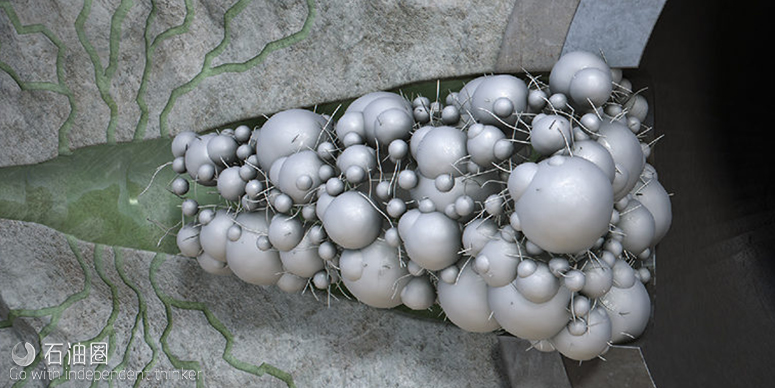
AquaBond地层减水技术改变了支撑剂充填层的相对渗透性,使油气进入,减少水的进入。该充填物作为半透膜,选择性地允许油气渗透,同时排斥地层水。对支撑剂涂层官能团进行修改后,形成了疏水亲油性的临界表面张力。这就产生了一种驱动力,使支撑剂充填层能够吸收石油,同时减少水在支撑剂充填层中的流动。
由于支撑剂充填层是一种多孔介质,如果水是唯一与充填层接触的流体,那么它就可以流过充填层。这可以防止在支撑剂充填层或地层表面/支撑剂充填界面出现水堵现象。通过修改上文描述的试验就可以证明这一点。将起始水/油比调节至5:1,因此在试验开始时仅有水与支撑剂芯柱接触。用传统树脂涂覆的支撑剂进行对比试验,即使在油与支撑剂芯柱接触后,仍继续注入水,大部分油仍留在储层内。
为了证明该技术在油田的有效性,在德克萨斯州Panhandle罗伯茨县与亨普希尔县的Granite Wash地层进行了试验。一家油气公司在两口水平井中使用了AquaBond技术,并将其与11口邻井水平井进行了比较。试验井利用该技术,泵入23%的40/70地层减水剂支撑剂尾浆,以及剩余的都是未涂覆压裂砂。三口邻井采用了23%的40/70统树脂涂层支撑剂尾浆,另外八口邻井采用了100%未涂覆的压裂砂。
数据集中所有井的完井细节类似:垂深接近11000英尺,水平段4000英尺,井底静态温度为180华氏度。所有井的支撑剂用量约为230万磅。在整个作业期间,采用传统树脂涂层支撑剂的邻井与采用未涂覆压裂砂的邻井表现大致相同。采用AquaBond技术的井的含水率比邻井低30%。平均累积产水量降低了43%,对产出总液量并无影响。
在水力压裂作业中,不需要特殊设备就可以实现地层减水。地层减水方案概述如下:利用与传统支撑剂相同的方法,将之泵入井下;按照常规的回流程序,压裂液返回地面;油气与地层水接触到化学变化的支撑剂填充层;AquaBond技术使油气比水更优先流动;采出更多的油气(更少的水)至地面。
作业后分析可以根据产量数据优化未来的完井设计。根据地层特征、预期减水效果和/或水问题的严重程度,可以采用领浆、尾浆或全支撑剂设计。该技术还可以作为现有高含水井重复压裂的补救措施,并已成功应用于该领域。由于其灵活性与易用性,该技术应被视为压裂设计中很重要的一部分,并纳入有效的水管理策略。
实验测试结果表明,AquaBond技术可使油比水优先流出。这些测试已经重复多遍,使用了来自北美不同地区的不同原油与采出水的样本。通过改变水/油比也改变了测试。当进行实验室测试时,只有水与含有AquaBond技术(或固结支撑剂充填层)的芯柱接触时,不会发生水堵现象。
该技术已用于Permian区块,Bakken页岩区块, Granite Wash地层以及Haynesville页岩区块。采用与传统支撑剂相同的方法,无需特殊设备。以Granite Wash地层为例,说明了该技术可以在不影响总流体产量的前提下,降低地层水产量。
Produced water, or formation water, is naturally occurring water that is brought to the surface during oil and gas production. It is by far the largest by-product for the industry. While there is significant variation in the amount of formation water generated from established oil-and-gas-producing regions in the country, it is estimated that for every barrel of oil recovered, 4 to 10 bbl of formation water will be produced.
THE PROBLEM
Formation water often contains salts, bacteria, organic chemicals and other contaminants.1?Although some companies will treat the water for re-use in hydraulic fracturing or agriculture, this is not always an economical option. Most of the formation water is disposed of by injecting it into subterranean wastewater disposal wells.
The U.S. upstream industry will spend an estimated $34.7 billion on water management in 2018. A complex logistical network accounts for storing, transferring, trucking, treating and disposing of formation water, and totals 89% of water management costs.2?Over the life of an individual well, formation water costs can total $6 million, representing up to half of a well’s operating expense.3?These costs are predicted to increase.
Formation water handling and disposal continue to be important topics in the oil and gas industry, but little is being done to limit water production by addressing the issue at the source. An ideal solution to the challenges presented by the management of produced water would include reducing the amount of formation water generated without hindering hydrocarbon production. Current technologies, such as gels or swelling chemicals, can limit formation water production, but they restrict the flow of hydrocarbons.
THE SOLUTION
Researchers at Hexion were determined to develop a solution that would reduce formation water production, while maintaining oil and gas output. Technologies, such as OilPlus proppants, have demonstrated the ability to improve production in liquid-rich reservoirs by altering the surface chemistry of the proppant.5?The lessons learned from tailoring surface chemistry were leveraged to develop the patented AquaBond formation water reduction technology.
Fig. 2. Schematic of the AquaBond technology test apparatus.
This technology has proven to reduce produced water by as much as 50%, while improving oil and gas production compared to offset wells. Since the technology is bonded to proppant, the water-reducing property stays effective for the life of the well. Utilization of the technology can increase well profitability by reducing costs associated with wastewater management, ultimately leading to a lower cost per barrel of oil equivalent (boe).
HOW IT WORKS
The AquaBond formation water reduction technology alters the relative permeability of the proppant pack to admit hydrocarbons and reduce the admission of water. The pack acts as a semi-permeable membrane to selectively allow hydrocarbons to penetrate while excluding formation water.
Modifications to the functional groups of the proppant coating result in a tailored critical surface tension that is hydrophobic and oleophilic at the same time,?Fig. 1.?This creates a driving force that tends to admit oil into the proppant pack, while reducing the flow of water through the proppant pack.
AVOIDING A “WATER BLOCK”
Since the proppant pack is a porous medium, water can flow through the pack, if it is the only fluid in contact with the pack. This prevents a water block scenario from occurring in the proppant pack or at the formation surface/proppant pack interface. This was proven by modifying the previously described test. The starting water/oil ratio was adjusted to 5:1, so only water was in contact with the proppant core at the start of the test.?Figure 4?is a picture of the AquaBond technology proppant core at the start of the modified test. The control test with traditional resin-coated proppant continued to flow water, even after oil contacted the proppant core, leaving a majority of the oil in the reservoir cell.
Fig. 4. AquaBond technology proppant core is only in contact with water at the beginning of the 5:1 water/oil ratio test. This core flows water until the oil (dyed blue) makes contact.
CASE STUDY
To prove that this technology is effective in the field, a trial was conducted in the Granite Wash formation of Roberts and Hemphill counties in the Texas Panhandle. A single operator utilized AquaBond technology on two horizontal wells, which were compared to 11 nearby offset horizontal wells. The wells utilizing this technology consisted of a 23% tail-in of 40/70 formation water-reducing proppant and a balance of uncoated frac sand. Three of the offset wells used a 23% tail-in of 40/70 traditional resin-coated proppant, and eight wells used 100% uncoated frac sand.
Completion details were similar for all wells in the data set: true vertical depth (TVD) was approximately 11,000 ft, with a lateral length of 4,000 ft, and bottomhole static temperature was 180°F. All wells used approximately 2.3 million lb of total proppant.
Over the entire period, the traditional resin-coated proppant offsets and the uncoated frac sand wells performed about the same. The AquaBond technology wells had a 30% lower water cut, compared to the offsets. Average cumulative water production was reduced 43%, and no impact to total fluid production was observed.
HOW TO USE THE TECHNOLOGY
The formation water-reduction technology requires no special equipment for use in hydraulic fracturing. The formation water reduction plan is outlined below:
- Pump downhole, using the same method as traditional proppants.
- Frac water returns to the surface, per typical flowback procedure.
- Hydrocarbons and formation water contact the chemically altered proppant pack.
- The AquaBond technology preferentially flows hydrocarbons over water.
- More oil and gas (and less water) are produced to the surface.
Post-job analysis can be used to optimize future completion designs, based on production data. Lead-ins, tail-ins or total proppant designs can be utilized, depending on formation characteristics, desired water reduction and/or severity of water issue. The technology also can be used as a remedial treatment for refracturing existing high-water-cut wells and has been used successfully in this application. Due to its flexibility and ease of use, the technology should be considered as a responsible part of any frac design incorporating an effective water management strategy.
CONCLUSION
Laboratory tests demonstrate that AquaBond technology will preferentially flow oil over water. These tests have been repeated multiple times, using different crude oil and produced water samples from various regions throughout North America. Testing also has been modified by varying water/oil ratios. When performing laboratory tests with only water in contact with the core incorporating AquaBond technology (or consolidated proppant pack), it was demonstrated that a water block will not occur.
This technology has been utilized in the Permian basin, Bakken shale, Granite Wash formation, and the Haynesville shale. It is applied using the same method as traditional proppants and requires no special equipment. The case study in the Granite Wash demonstrates how this technology can reduce the production of formation water without impacting total fluid production.?