HydraWell推出的弃置封堵技术一次下钻即可完成作业,作业效果显著改善。
编译 | TOM 惊蛰
自2017年5月以来,HydraWell一直在执行Valhall油田老钻井平台(DP)10口已关停油井的弃置封堵作业。近日,通过在Valhall油田使用PWC(射孔/清洗/注水泥)封堵弃井(P&A)技术,HydraWell公司成功帮助Aker BP提前完成了封堵计划。
与2014年至2016年DP平台上第一阶段的封堵弃井作业相比,Aker BP在最新阶段将每口井的平均作业时间减少了50%,尽管在作业结束时井筒复杂性有所增加。在DP平台上执行井筒封堵是Valhall油田迈向现代化的关键部分。从1982年开始采油的三个老平台QP、DP与PCP将被拆除,在移除DP平台之前,需要将剩余四口井永久封堵。
Aker BP公司封堵弃井部门工程经理Martin Straume说:“通过改进一些关键元素,我们显著缩短了封堵弃井作业的时间。HydraWell公司的HydraHemera PWC技术就是这些主要元素之一。除此之外,我们还进行了计算机模拟,以确定在固井开始之前,需要多长时间清洗套管内壁。这加深了我们的认知,意味着我们可以比以前更快的完成作业。”
Straume补充道:“此外,我们与HydraWell一起,已经开始在适用的油井中下入单趟作业系统。这意味着我们将射孔枪下入井中,而不是在我们开始清洗之前将其起出。这有助大幅缩短作业时间。”HydraWell公司的HydraHemera PWC系统在清洗套管前,对油井进行射孔,然后注入水泥塞,形成符合Norsok标准的岩石间的屏障。利用该系统,可在不到两天时间内布置岩石间的屏障,目前该技术可用于单层套管与双层套管井。
HydraWell业务开发副总裁Arne G. Larsen说:“令人印象深刻的是,Aker BP公司是如何不遗余力地在作业时间、HSE以及成本方面取得进步的。我们引以为豪的是为这项伟大的工作贡献了技术与知识。PWC系统降低了每一次封堵作业的成本、HSE风险,减少了对环境的影响,因此我们认为,我们的技术符合Aker BP的雄心壮志,是最佳拍档。”
据英国石油天然气管理局估计,井筒的弃置封堵费用约占井筒开发总成泵的 48% (根据英国石油天然气管理局的数据),而井况复杂的井筒作业成本更是接近数千万美元,而且这是一项不会带来收入的作业,让人非常头疼。
一些公司希望减轻这种痛苦,开发出类似热固性封堵方案以及等离子体钻进技术。挪威的Hydrawell公司是PWC领域的先行者。该公司的PWC解决方案包括一套工具,能够帮助作业者降低需要分段磨铣的封堵弃井的成本,从大约10-14天的工期两天的一趟钻即可完成该项作业。
据悉,Aker BP公司正评估其最新工具组合的无钻机版本,以进一步降低成本,同样,该公司也在评估新的屏障验证技术,避免为了重新测井,重新钻进刚布置的水泥屏障。开发HydraHemera系统是为了能够在多个环空中封堵油井,且无需执行分段磨铣作业。
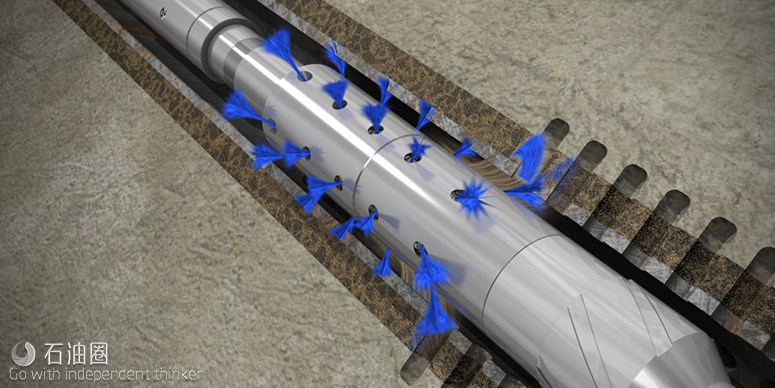
HydraHemera系统由两个部件组成,HydraHemera喷射工具与HydraHemera注水泥工具。HydraHemera喷射工具用于清洗与清除套管射孔残留在环空中的碎片,它具有多个喷嘴,定位在不同的角度,并设计成最优配置与喷射流速。这些射流可穿透并彻底清洗多层已射孔的套管。
在封堵材料注入截面前,HydraHemera喷射工具可确保套管环空处于最佳状态。碎屑、旧泥浆、重晶石以及旧切屑被干净的泥浆取代。射流清洗后利用投球机制,激活HydraHemera注水泥工具,并与HydraArchimedes工具结合,可将封堵材料置于多重环空的横截面内,从而在井中建立适当的屏障,用于封堵弃井或侧钻作业。
再具体应用中,完成一趟射孔后,会在目标区域留有大尺寸的射孔孔眼,然后将HydraHemera下至井中射孔段的顶部。HydraHemera Bull Nose可实现下入时的循环。投球后,激活清洗喷嘴。泵入清洁泥浆,从HydraHemera中喷出高能量射流,彻底清洁两层套管后的环空。第二次投球将激活HydraHemera注水泥工具中的水泥喷嘴,该工具拥有针对水泥优化的过流面积。在钻具组合旋转的同时泵送水泥,并利用HydraArchimedes工具将水泥有效地注入中间与外部环空中。
技术特点:
- 一趟下钻完成封堵;
- 无需磨铣;
- 起下钻时可循环;
- 设计与操作简单;
- 适用于单个与多个环空的清洗;
- 适用于所有尺寸的套管。
Through utilization of the PWC (Perforate, Wash & Cement) plug and abandonment method (P&A) on the Valhall field, HydraWell has contributed towards Aker BP executing its plugging program significantly quicker than planned.
Since May 2017, HydraWell has contributed towards plugging 10 shut-in wells on the original drilling platform (DP) at the Valhall field center.
Compared to the first P&A phase on the DP platform from 2014 to 2016, Aker BP has reduced the average time per well by 50% in the latest phase, despite a rise in the complexity of the wells towards the end of the campaign.
Plugging wells on the DP platform is a key part of the work to modernize the Valhall field center. The three original platforms from when the field started producing in 1982 – QP, DP and PCP – will be removed. Four wells remain to be permanently plugged prior to the removal of the DP platform.
“We have significantly reduced the execution time of our P&A operations through improving a number of elements. HydraWell’s PWC technology, with HydraHemera in front, is one such element. Among other things, we have run computer simulations to identify how much time we need to wash the back of the casing before the cementing starts. This has improved our understanding and means that we can do things faster than before,” says Martin Straume, drilling engineering manager plugging and abandonment, Aker BP.
“In addition, together with HydraWell we have started running one-trip systems on applicable wells. This means that we drop the perforation gun into the well instead of pulling it back up before we start washing. This has contributed towards reducing execution time significantly,” Straume adds.
HydraWell’s HydraHemeraTM PWC system perforates the well before washing the casing and then setting the cement plug – a so-called rock-to-rock barrier that is required under the Norsok standard. Through this method a rock-to-rock barrier can be installed in less than two days. The technology can be utilized on both single and dual casing wells.
“It is impressive to witness how Aker BP leaves no stone unturned to identify improvements with regards to execution time, HSE and costs. We are proud to contribute with technology and knowledge towards this work. PWC reduces both costs, HSE risks and the environmental footprint of each plugging operation, so we feel that we are a good match for Aker BP’s ambitions,” says Arne G. Larsen, HydraWell’s vice president of business development.
Amounting to an estimated 48% of decommissioning costs (according to the UK’s Oil and Gas Authority) and with “train wreck” wells costing nearly double-digit million dollar figures, it’s an activity that brings in no revenues, just headaches.
There are firms looking to ease the pain, developing the likes of thermite plug solutions and plasma drilling technology. Something less exotic is starting to make in-roads into the P&A space, however: perforate, wash and cement (PWC) tools and methodologies. Norway’s Hydrawell was a first mover in the PWC space. The firm’s PWC solutions comprise a suite of tools helping to cut well P&A cost, where section milling would have been required, from ca.10-14 days to just two, when run as a one-trip solution.
The firm is assessing options for a rigless version of its latest tool portfolio, to further reduce costs, as well as technologies for barrier verification, without having to redrill the just installed barriers – for re-logging.
The HydraHemera? system was developed to enable plugging a well across multiple annuli without performing a section milling operation.
The system consists of two components, a HydraHemera? Jetting Tool and a HydraHemera? Cementing Tool. The HydraHemera? Jetting Tool is used to wash and clean out debris in the annuli behind perforated casings. It features jet nozzles which are positioned at irregular angles and engineered for optimum configuration and exit velocity. The jets penetrate and clean thoroughly behind multiple perforated casings.
The HydraHemera? Jetting Tool ensures optimum conditions in the casing annuli prior to placing the plugging material in the cross section. Debris, old mud, barite and old cuttings are replaced by clean mud.
Using a ball drop mechanism after jetting, the HydraHemera? Cementing Tool is activated, and combined with the HydraArchimedes? tool enable placing plugging material in the entire cross section of multiple annuli, and hence, establishing a proper barrier in the well for P&A or sidetrack purposes.
OPERATION: After completing a perforating run with big hole charges in the target zone, the HydraHemera? system is run in hole to the top of the perforated section. The HydraHemera? Bull Nose allows for circulation while running in hole. A ball is dropped which activates the cleaning nozzles. Clean mud is pumped which exits the HydraHemera? as high energy jets, thoroughly cleaning behind up to two casing strings. A second ball drop activates the cementing nozzles in the HydraHemera? Cementing Tool, which feature flow area optimized for cement. Cement is pumped while rotating the assembly, and the cement is placed efficiently into the intermediate and outer annuli utilizing the HydraArchimedes? tool.
FEATURES/BENEFITS: · One trip plugging system · No milling required · Allows full flow when tripping in and out · Simple design and operation · Ideal for cleaning single and multiple annuli · Available for all casing sizes