新型井救援工具RWIS可以发挥真正的事半功倍效果!
编译 | 惊蛰 TOM?
Trendsetter工程公司与Add能源公司结合了他们在井控工程与设备设计方面的专业知识,开发出救援井注入工具(RWIS)。鉴于传统的救援井方法在实际应用中的低效率问题, RWIS系统可通过一口救援井,利用多艘泵船,每分钟可泵入200桶的压井泥浆,作业效率显著提高。
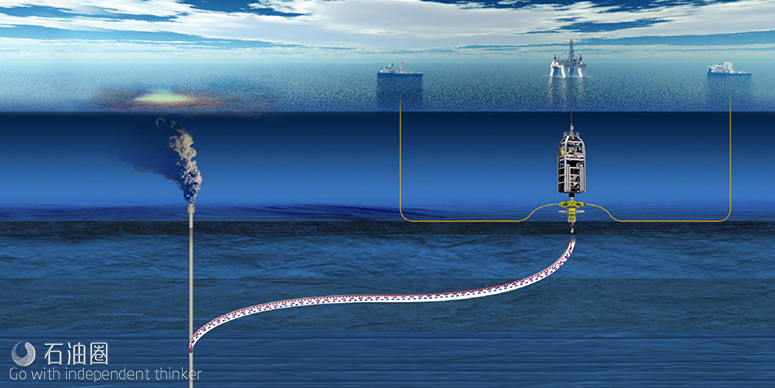
在救援井与井喷井相交之前,RWIS被设计安装在救援井中,位于井口与防喷器(BOP)之间,作为一个水下注入歧管,为泵送压井泥浆提供额外的入口。每一个入口都配备有双重故障防护隔绝阀,为救援井提供必要的压力控制手段。在压井作业期间,位于救援井钻井平台附近的一艘或多艘高压泵船,将利用高压柔性管线连接至RWIS入口,以提供额外的泥浆泵入。RWIS可以通过空运、陆运以及海运快速部署到世界任何地区,适用性极强。Trendsetter公司表示,RWIS已被要求用于挪威与美国的特殊油井,并已经于2016年底成功投入商业应用。
自2010年以来,Trendsetter工程公司与Add能源公司已在多个项目上合作。2015年,两家公司合作的目的是进一步开发有利于能源行业的技术,提高安全性,提高钻井作业的经济效益,从而开发出了RWIS。利用Trendsetter公司的海底工程经验以及Add 能源公司针对井喷、井控事故的专家现场支持,两家公司为井底动态压井的救援井应用,研发出突破性的工具。
RWIS是一种增加单口救援井流量的装置。在许多情况下,相比于钻探多口救援井,这是更安全且且更具挑战性的选择。RWIS位于救援井口与防喷器之间,它为多艘泵船提供了入口,这些泵船通过柔性管线进行水力连接,并将压井液注入救援井。对于压井需求更低的井喷,RWIS仍可选择更浅的相交点深度,以节省作业时间并限制溢流量。当动态压井需求可能会影响到井设计时,RWIS可以在套管、完井作业以及油田开发方面节省大量成本。
RWIS是一种获得专利的水下专业设备,使作业者能够通过一口救援井安全有效地阻止高产油藏的井喷。RWIS通过移除了限制性节流以及水面船只至海床的管线所造成的瓶颈,增加了井喷井注入压井泥浆的泵排量。
RWIS的设计与制造目的是提高泵入效率,通过每分钟向一口救援井泵入超过200桶的压井泥浆,大大提高单口救援井的泵入能力,这是常规救援井可实现的压井泵速的四倍。相对于需要多口救援井的方法,利用多艘泵船的方法拥有显著优势。
RWIS除了能够确保单口救援井的应急措施之外,还可使作业者优化经济效益,并帮助他们解锁通常不会被批准的项目。在应用RWIS时,作业者能够通过增加井筒的完井尺寸、降低资本支出成本以及产量最大化,来遵守法规并减少满足产量目标所需的井数。
RWIS的优势
在项目开发期间,RWIS增加井筒的完井尺寸,使井筒流量最大化,同时通过更少的井筒即可满足产量目标,确保项目在预算范围内开发。在油气溢流期间,通过大排量向井喷井中泵入压井液,实现快速压井,通过简化方案提高压井作业的安全性,将泵送系统与储罐从钻井平台转移至专用的泵船,确保不需要调整钻机,且不会妨碍一级井控设备,同时得益于重量与尺寸,可以轻松调动与运输。
案例研究
根据安全指导方针,Add能源公司的一位客户要求对一口近海浅层气井进行井喷应急处理。这类井的井喷压井往往面临许多挑战,包括在动态压井期间仅有很窄的深度窗口,来建立静液柱压力与摩擦压耗,并且需要高压差来平衡油藏压力。对于最严重的井喷情况,使用RWIS可以确保用一口救援井就能控制住这些井。
Add能源公司的井控与流体模拟专家利用设计井身结构以及预测储层性质,模拟了最严重的井喷情况。模拟中使用了一口安装有RWIS的救援井,将压井泥浆泵入目标井筒。使用不同的压井泥浆与硬件配置进行了多次迭代,以实现成功的压井。
最严重情况下,该井的气体排放量约30亿立方英尺/天,动态压井期间使用RWIS,以230 bpm的总速率泵送压井泥浆。第二口救援井连接至RWIS泵速达到180 bpm,而第一口救援井仅有50 bpm;对硬件配置进行了HHP规定、泵曲线、额定压力、腐蚀速度、疲劳极限、系统冗余以及其他约束的评估,研究表明,在这种情况下,可以通过单口救援井压住最坏情况下的高产井的井喷。
Trendsetter Engineering and Add Energy have combined their expertise in well control engineering and equipment design to develop the relief well injection spool (RWIS).
The RWIS is designed to enable pumping of up to 200 barrels per minute of kill mud through a single relief well utilizing multiple vessels as opposed to the conventional method of multiple relief wells.
The RWIS is designed to be installed on a relief well prior to intersecting the blowout well and would be positioned between the wellhead and the blowout preventer (BOP), becoming a subsea injection manifold providing additional inlets for pumping kill mud. Each of these inlets is equipped with dual fail-safe barrier valves to provide the necessary means of pressure containment in the relief well. During the well kill operation, one or more high-pressure pumping vessels located near the relief well rig will be connected to the RWIS inlets using high pressure flexible flowlines to provide the additional mud fluid. The RWIS can be rapidly deployed by air, ground and marine freight to any region of the world.
The RWIS has already been requested for specific wells in Norway and U.S.A, and should be available to the market by the end of 2016, the company said.
Since 2010, Trendsetter Engineering and Add Energy have teamed to work together on multiple projects. In 2015, the companies came together with the aim to further develop technology that benefits the energy industry by increasing safety and allowing for more cost-effective drilling operations, resulting in the development of the Relief Well Injection Spool (RWIS). Utilizing both Trendsetter’s subsea engineering experience and Add Energy’s expert on-site advisory for blowouts and well control incidents, the two companies created a breakthrough tool for dynamic bottom kill relief well applications.?
The RWIS is a device that increases the flow capacity of a single relief well. In? many scenarios, this is a safer and less challenging option to drilling multiple relief wells. The RWIS sits between the relief wellhead and the BOP, and it provides inlets for multiple pumping vessels to hydraulically connect via flexible lines and inject kill fluid into the relief well (see figure). For blowouts where the kill requirements are lower, the RWIS may still provide benefits by allowing a shallower intersect that saves time and limits the spill volumes. In cases where the dynamic kill requirements drive the well design, the RWIS may provide significant savings on the casing, completion and field development.?
The Relief Well Injection Spool (RWIS) is a patented specialist subsea equipment that enables operators to stop a blowout from prolific reservoirs safely and efficiently via a single relief well. This is made possible with the RWIS by increasing the pump rate of kill mud into the blowing well by removing the bottle-neck caused by restrictive choke and kill lines from the surface vessel to the seabed.
The RWIS has been designed and built to significantly increase the pumping capacity of a single relief well by pumping in excess of 200 barrels of kill mud per minute through a single relief well, four times as much kill fluid as typically achievable. A significant advance for the industry which utilizes multiple vessels as opposed to the alternative method requiring multiple relief wells.
In addition to the RWIS assuring single relief well contingency, the RWIS also enables operators to optimize well economics and help unlock projects that wouldn’t normally be sanctioned. In purchasing access rights to the RWIS, operators are able to comply with legislation and reduce the number of wells required to meet production targets by increasing the completion size of the well bore, reducing CAPEX costs and maximizing production.
Benefits of using the RWIS:
During project development:
- Complies with legislation and company policy by guaranteeing single relief well contingency
- Enables the completion size of the well bore to be increased, maximizing well flow rates
- Allows production targets to be met with fewer wells, assuring the project can be developed within budget
- Helps to build a business case for project sanction
During a hydrocarbon release:
- Enables rapid kill of a blowing well – through high rate pumping of kill fluids into a blowing well
- Improves safety of a well kill operation through a simplified solution
- Enables relocation of pumping and storage off the rig to dedicated pumping vessels
- Ensures no rig modifications are required or interference with primary well control equipment
- Allows easy mobilization and transportation due to weight and size
PROJECT SHOWCASE
Add Energy was approached by a client who, according to company safety guidelines, requested a blowout-contingency study for an offshore shallow gas well.
A blowout intervention for these types of wells are often faced with many challenges including a narrow depth window to build hydrostatic and frictional pressure during a dynamic kill combined with high pressure differential to balance the reservoir pressure. For a worst-case blowout scenario, using a relief well injection spool (RWIS) may ensure the ability to bring such wells under control with a single relief well.?
WHAT WE DID
The Add Energy well-control and flow-simulation specialist modeled the worst-case-blowout scenario using the planned wellbore schematic and predicted reservoir properties. A single relief well with an RWIS installed on its wellhead was used in the simulations to pump kill mud into the target wellbore. Several iterations were made using different kill muds and hardware configurations to achieve a successful kill.
RESULTS
- A worst-case gas discharge of around 3 Billion SCF/Day
- A dynamic kill using the RWIS to pump a heavy mud at a combined rate of 230 bpm
- 50 bpm down primary relief well and 180 bpm down secondary relief well connected to the RWIS
- Hardware configuration was evaluated for hhp requirements, pump curves, pressure ratings, erosional velocities, fatigue limitations, system redundancy and other constraints
- The study demonstrated that a prolific worst-case blowout scenario could in this case be killed with a single relief well