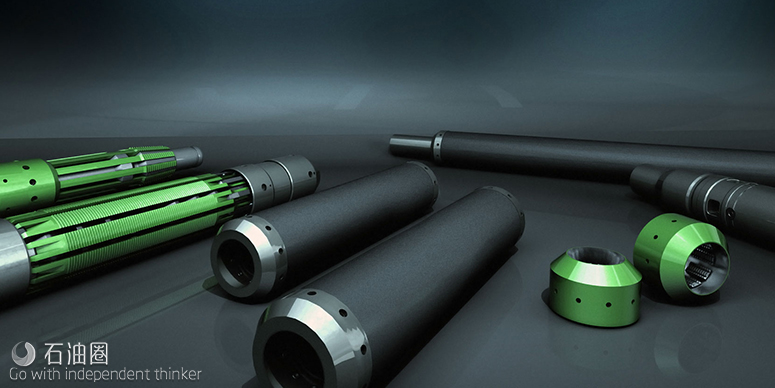
针对裸眼井的密封隔离难题,Reactive公司推出了多款有效工具。
编译 | 惊蛰 TOM
Reactive公司推出的Reflex裸眼封隔系统包括多个工具,可在整个井筒内隔离地层水产出段,降低采出水量。该系统利用Reactive独有的膨胀式封隔器,可用于高盐度流体或液态烃。得益于双向卡瓦的设计,封隔器组件下入至预定深度后即可坐封,无需等待封隔器达到完全密封。
该工具具备优点包括:1、可在高盐度流体中膨胀;2、双向卡瓦的大接触面,可减少对地层的影响;3、可根据客户需求,定制封隔器的额定压力与流体适用性;4、可安装于桥塞或跨式双封隔器中。
当裸眼段地层强度存在变化时,卡瓦与地层之间的最大接触面积尤为重要。Reflex工具拥有耐用的双向卡瓦,能够与井壁形成较大的接触区域,从而可将ReflexHP膨胀式隔离封隔器坐封到位。
Reflex?膨胀式封隔器已在全球成功应用多次,经受住了众多现场考验,坐封成功率高达100%,其中包括具有挑战性的高压应用。油气水三相流中,该设备在不同温度下进行了多种严苛测试,可确保膨胀速度、最大承压与最终膨胀体积。
Reflex HP膨胀式隔离封隔器是一种高压密封方案,具有膨胀弹性体,可根据客户要求直接安装于OCTG管柱、套管或心轴。Reflex HP膨胀式隔离封隔器通常用于裸眼封隔,以及表层套管与技术套管的环空封隔,适用于各种井况,包括:高温至超低温环境、大型冲淤构造、快速膨胀、超低速膨胀、高氯化物、外来盐水、高含水、以及深水海底热应用。
作为Reflex HP的小兄弟,Reflex Lite膨胀式隔离封隔器是一种滑套组件,可在作业现场轻松安装到OCTG管柱或套管上,并利用端环固定到位。Reflex Lite有多种组件长度可供选择,最长可达1米(3.2英尺),适合所有管柱尺寸。由于Reflex?Lite的组件未与中心管连接,因此管柱可在组件内旋转,从而在管柱旋转时大大降低了组件损坏的风险。端环可提供高达200 klbs的锚固力。
得益于模块化设计,Reflex Lite可针对不同应用,调整其配置:1、用于低压应用的单个组件,例如ICD/筛管完井;2、用于存在潜在冲蚀段的低压应用的单个封隔组件;3、用于高压应用的堆叠组件,例如增产作业;4、用于高含水井,可选择油(Reflex? Lite)与水(Reflex Lite H2O)膨胀组件。
Reflex Lite易于装运与存储,是一种经济高效的模块化解决方案,可为开发商设计与应急方案提供灵活性。其应用优势包括:1、无需机械延迟;2、模块化设计提供灵活性;3、兼容外来与高盐度盐水;4、通过酸、硫化氢与二氧化碳耐受测试;5、对所有常见油田化学品的耐化学性;6、可定制膨胀次数,以实现安全部署;7、交货时间短。
固井水泥胶结程度差导致的隔离失效是油气行业作业的一个常见问题。它可能发生在井的生命周期的不同阶段,从初次固井的水泥充填不足,到温度和/或压力波动导致的水泥逐渐失效。为此进行的修井与干预是一项昂贵且费时的作业,但可以将膨胀式封隔器与水泥胶结段结合使用,来避免上述问题。
为了更好地理解两个潜在高产油藏之间的地层封闭层,中东一家油气公司正进行实验井的钻井与完井作业。确认这一障碍的完整性,对于制定准确的油田开发计划至关重要。
最初的完井设计要求利用尾管注水泥作业封固这三层地层。在这种情况下,双层完井管柱在生产封隔器的上方与下方都安装了压力与温度测量仪,可在射孔后监测两层之间的流动情况(如果有的话)。
然而,水泥屏障的完整性可直接影响能否成功收集上述数据。为了达到这一目的,需要将膨胀式封隔器与尾管外的水泥胶结相结合,以提供一个辅助的、失效保护的屏障,在水泥失效时,可以激活该屏障。
因此封隔器不能阻碍初次注水泥作业,必须具有足够的长度以覆盖所有三层地层,并能够坐封于任何深度。Reactive公司致力于设计既能够满足作业要求,也能够满足作业者独特需求的封隔器。为了确保不会对初次注水泥作业产生影响,通过分析作业过程中观察到的流体,来控制封隔器的直径。
检查每个井段的流变性,可以确认封隔器在部署与胶结过程中会缓慢膨胀,这确保了水泥可在环空中保持循环,但如果发生油气侵入,封隔器仍会迅速膨胀。这种组合确保了初次水泥充填,同时也可在发生事故时,有效地控制住事故。
由于Reactive公司的生产设备能够处理长达46英尺、直径达到30英寸的大型套管接头,因此该公司能够生产出比平均尺寸大得多的封隔器,同时能够跨越三层地层。
这种类型的安装对于作业者与Reactive公司来说是首次尝试。通过与技术团队在现场协同作业,Reactive公司能够提供可靠的专业知识与技术支持,以帮助寻求正确的解决方案,再次证明该公司拥有最前沿的膨胀式封隔器技术。
The Reflex? Open Hole Isolation System isolates unwanted water production throughout the wellbore. Utilising Reactive’s proprietary swellable packers, the system is suitable for use in high salinity fluids or liquid hydrocarbon. The bi-directional slips allow the packer assembly to be released as soon as at depth, eliminating the requirement to wait until the packer has fully sealed.
- Swells in high salinity fluids
- Large surface area of bi-directional slips minimise impact on formation
- Customisable pressure rating and fluid compatibility
- Can be deployed in bridge plug or straddle packer configurations
In an open hole environment where formation strength can vary, maximum surface contact between the slips and formation is critical. The Open Hole Anchor contains durable bi-directional slips providing a large contact area with the wellbore, anchoring the Reflex? HP Swellable Isolation packer in place.
With a 100% success rate in over 24,000 installations worldwide, including particularly challenging high pressure applications, Reflex? Swellable Isolation packers have a field-proven pedigree. The Reflex? HP has been rigorously tested in a multitude of hydrocarbon and water based fluids as well as a broad range of temperatures to confirm swell speed, maximum differential pressure capability and final swell volume.
Reflex? HP
The Reflex? HP Swellable Isolation Packer is our high-pressure seal solution, with swelling elastomers that are bonded directly to OCTG tubing, casing or mandrels, per customer application.
Commonly used in open-hole isolation, as well as intermediate and surface casing annular isolation, Reflex? HP Swellable Isolation Packers cover a wide range of well conditions – high temp to ultra low temp environments, large wash-out coverage, fast swell, ultra-slow swell, high chlorides, exotic brines, high water cut, including deep water sea-bed thermal applications.
Reactive Downhole Tools’ technical staff can design and test Reflex? HP Swellable Isolation Packers for a bespoke solution to the most perplexing environments.
- Element lengths of up to 10-m (35-ft) can be manufactured to suit all pipe sizes.
- Manufacturing occurs in-house enabling very short lead times.
- Provided in oil, water and combination compounds.
Reflex? Lite
As the little cousin of the Reflex? HP, the Reflex? Lite Swellable Isolation Packer is a slip-on element, which can be easily installed onto OCTG tubing or casing at the work-site and secured in place with end-rings. Reflex? Lite is available in a range of element lengths up to 1-m (3.2-ft) and to suit all pipe sizes.
Because Reflex? Lite’s element is not bonded to the base pipe, the tubing can rotate within the element which drastically reduces the risk of element damage under rotation. End-rings are available with up to 200-klbs anchoring force*.
The modular design of Reflex? Lite means that it can be deployed in multiple configurations:
- Single element for low pressure applications, e.g. ICD/screen completions.
- Individual spaced elements for low-pressure applications with potential washouts.
- Stacked elements for higher pressure applications, e.g. stimulation.
- Alternate oil (Reflex? Lite) and water (Reflex Lite H2O) swell elements for high water-cut wells.
Reflex? Lite – an easy to ship and store, cost-effective modular solution, giving flexibility to your planning and contingency options.
ADVANTAGES:
- No mechanical delay required
- Modular design gives flexibility
- Compatible with exotic and high salinity brines
- Acid, H2S and CO2 tested
- Chemical resistance to all common oilfield chemicals
- Engineered swell times for safe deployment
- Short lead times
Isolation failure from poor cementation is a common problem faced by the industry. It can happen at various points during the life cycle of a well – from an initial poor primary cement placement through to gradual failure due to temperature and/or pressure fluctuations. Workover and intervention of poor cement is a costly and timely activity, but such problems can be avoided by using swellable packers in conjunction with the cemented sections.
A Middle East operator was drilling and completing a pilot well to better understand the sealing layer of formation between two potentially productive reservoirs. The confirmation of the integrity of this barrier was critical to the creation of an accurate field development plan.
The primary completion design called for a cemented liner straddling all three layers. Within this, a dual completion string with pressure and temperature gauges above and below a production packer would allow post perforation monitoring of flow, if any, between the layers.
However, the integrity of the cemented barrier was critical to the success and validation of the data gathered. To aid this, a swellable packer was required to run as part of the outer cemented liner to provide a secondary, failsafe barrier which would activate in the event of a cement failure.
The packer therefore could not impede the primary cement application, and had to be of sufficient length to overlap all three layers and allow for any unforeseen off depth placement.
Reaction
Reactive worked to design a packer which was compatible with the unique requirements of the application and the operator. To ensure there would be no impact on the primary cement placement, the diameter of packer was controlled by analysing the fluid train that would be seen during operations.
Reviewing the individual rheology at each stage allowed Reactive to confirm that the packer would offer a slow swell during deployment and cementation – which ensured that cement circulation was maintained – but would still swell rapidly should hydrocarbon breakthrough occur.
This combination safeguards the primary cement placement, whilst still allowing difficulties to be contained efficiently should they occur.
As Reactive’s manufacturing facility has the ability to handle large casing joints of up to 46ft in length and 30” in diameter, it allowed for the manufacture of a packer which was far larger than an average size to simultaneously straddle all three formation layers.
This type of installation was the first of its kind for the operator, and Reactive. By working locally with the technical team, Reactive was able to offer sound expertise and support to aid in the correct solution, and reaffirming its abilities at the forefront of swellable technologies.