
NOV推出BlackBox HD测井工具,记录时长达150小时,可显著提升钻井作业效率。
编译 | 惊蛰 影子
过去十年中,油气行业人为了更好地将数据整合到钻井作业中付出了巨大努力。虽然各类技术显著改进,出现了大量用于收集井下数据(以便后续分析)的工具,但截至目前,大多数工具并不能直接从钻头中捕获数据。相反,它们被放置在底部钻具组合(BHA)中单独的短接,位置也各不相同,效率较低。
NOV的BlackBox HD工具是一种记忆模式测井工具,能够帮助操作人员解决常见的井下钻井功能障碍(例如粘滑和旋转)。根据BlackBox HD的记忆数据,可以在后续的钻井作业中做出更好的决策,提高整体钻井效率并降低油井成本。该工具没有非磁性环境要求,具有独立电源,不会干扰钻柱中的其他电子设备(图1)。
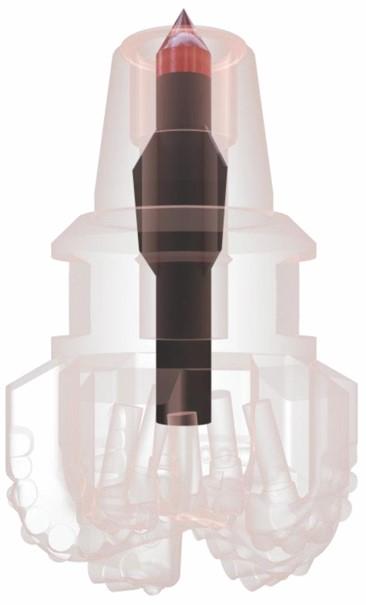
图1. BlackBox HD内置于钻头中
BlackBox HD的记录时长长达150小时,并以800 Hz的频率捕获高频突发数据。这些数据是NOV钻井优化服务的核心,钻井平台和NOV工程技术中心的专家通过分析数据,突出显示可以改变参数或设计的区域,达到提高钻井性能、克服钻井障碍的目的。
应用案例
在肯尼亚的一次钻井作业中,一家开发商钻遇坚硬的火山玄武岩,难度极大。NOV的FluidHammer钻井工具提供了一种新方法,可以在通过火山玄武岩层时保持高ROP。开发商要求更高的ROP,同时要避免产生过度的破坏性振动,防止损坏PDC钻头。所以,此次作业的主要目标是使用FluidHammer,一次下钻,稳定地钻穿火山玄武岩层,形成一个具有一定弧度、光滑的井筒。但是,该地区此前的作业主要以牙轮钻头为主,作业人员需要验证此次作业是否可以用PDC钻头,并且确认FluidHammer工具是否会造成过多的有害振动。
来自BlackBox HD的数据显示,FluidHammer工具将轴向震动保持在安全水平,可以维持PDC钻头的完整性,并且在FluidHammer接入BHA后,轴向和横向振动都显著变弱。 在此次作业中,平均ROP为18米/小时的底部ROP,通过火山玄武岩层的ROP高达16.6米/小时,钻井工具有效地与火山岩层接合而没有粘滑。钻井作业非常顺利,过程看似沉闷,结果却非常积极,高ROP缩短了近两天的作业时间(图2)。
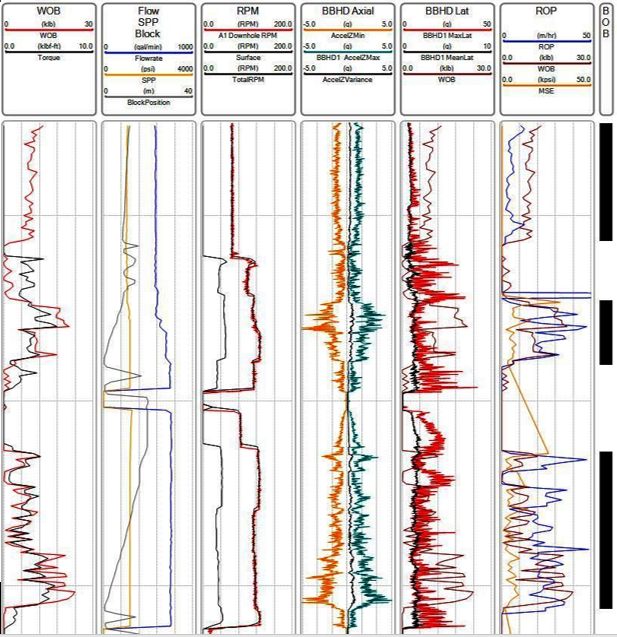
图2.钻井动态分析显示FluidHammer工具钻进非常高效、稳定
在另一次作业中,一家开发商在刚果近海区域要完成8-1/2 in长水平井钻进,但是作业中振动非常严重,无法准确控制钻进方向,有可能降低井筒的生产潜能。在使用BlackBox HD工具并执行相关的优化分析服务后,NOV确定了钻井障碍的根本原因为工具发生了严重的粘滑问题。
在滑移阶段,功能障碍转化为明显的横向振动,就可以通过加速度计记录到较慢的速度。这是因为偏离中心的加速度计难以分清径向与横向振动(由于滑动阶段剧烈的角加速度),导致人员做出降低RPM并增加钻头受重(WOB)。 虽然这是为了消除横向振动,但实际的误差会加剧粘/滑,如果操作员有正确的数据,他们就会做出正确的决定,即增加RPM并减少WOB。使用BlackBox HD后,数据量化了粘/滑的严重程度,确认了横向振动的缺乏。 数据证明旋转导向系统(RSS)不可能在具有如此高扭转振动期间保持工具面控制。
在运行NOV的增强测量工具之后(增加了高速ROP下WOB和位扭矩测量),作业人员发现井下BHA产生的扭矩可以忽略不计;相反,大部分扭矩和阻力来自重型钻杆,这导致了粘/滑。因为大部分扭矩来自沿着弦的阻力,提高转速仅增加了粘/滑的严重程度,并且由于缺少钻孔扭矩,降低WOB几乎没有效果。实际上,在这种扩展的水平应用中,小孔径井筒几乎总会遇到这样的问题,但由于等效循环密度限制,不能选择直径更大的管串。
在应用此工具之前,为了解决这个问题,作业人员提出了几个方案。但是在使用BlackBox HD并了解了参数、设备限制之后,NOV确定不能消除粘/滑,必须简单地将其降低到可接受的水平。 最终的解决方案是将RPM保持在一定范围以下,以便在滑移阶段RPM不会超过RSS工具控制极限。在滑移阶段,即使RPM超过顶部驱动RPM速度的200%,也可以实现这一点。所以通过保持工具的操作限制,运营商和服务公司也能够成功实现其定向钻进目标。在此次作业中,通过使用钻头内部的高频测量,了解了问题的根本原因,实现了最佳解决方案。
结论
由于非常规井的挑战,开发商对高质量数据收集和分析的需求不断增长。由于油价压力持续,油气行业需要更高的效率,钻井优化仍将是经济有效地实现目标和保持运营成功的重要方法。能够在钻头上收集高质量的井下数据和钻井动力学信息是实现钻井优化的重要一步,而BlackBox HD工具使这成为现实。
The case has been made repeatedly over the past decade to better integrate data collection into drilling operations. While significant technology improvements throughout this time frame have yielded an abundance of tools designed to collect downhole data for post-run analysis, most of these tools do not capture data directly from the bit; rather, they are placed in a carrier sub or various positions in the bottomhole assembly (BHA).
For more than a decade, National Oilwell Varco (NOV) has been measuring high-frequency at-bit and in-the-bit dynamics to further optimize bit and BHA designs as well as to provide information on optimal running parameters. Continuous advances in downhole technology at NOV have resulted in the development and iterative improvement of a tool that can be placed in the drillbit to measure tangential acceleration and angular position, which results in axial, lateral and torsional vibration and RPM values. Knowing such parameters acquired directly at the bit allows operators to optimize their drilling programs for challenging applications where significant drilling dysfunctions require superior bit performance.
NOV’s BlackBox HD tool is a memory- mode logging tool designed to help operators address common downhole drilling dysfunctions, such as stick/ slip and whirl, by enabling better decision-making in future wells to improve overall drilling performance and reduce well delivery costs. The tool has no nonmagnetic requirements and a self-contained power supply, meaning it does not interfere with other electronics in the drillstring (Figure 1).
The tool records for up to 150 hours of battery life and captures high-frequency burst data at 800 Hz. These data are the core component of a drilling optimization service provided by NOV, with subject matter experts both on the rig and in NOV engineering technology centers analyzing the data and highlighting areas where parameters or designs can be changed to improve drilling performance and overcome dysfunctions.
Case histories
An operator in Kenya was drilling a challenging section through hard volcanic basalts. NOV’s FluidHammer performance drilling tool offered a new method to fail the rock while maintaining high ROP through the volcanic basalts. The operator needed to achieve higher ROP without creating excessive damaging vibration, which would prematurely damage the PDC drillbit. The primary objective was to consistently drill the section through the volcanic basalts in one run, including drilling through the cement using the FluidHammer toolset with a bend to allow effective sliding and building to the tangent. The operator needed to validate that the section could be drilled with a PDC bit, as it had previously only used roller-cone bits, and that the FluidHammer tool would not cause excessive harmful vibration.
Data from the BlackBox HD tool at the bit revealed that the FluidHammer tool maintained axial oscillation within safe levels to maintain the PDC bit’s cutter integrity, and lateral vibration decreased with the FluidHammer tool engaged and BHA oscillating axially. On this run the operator achieved on-bottom ROP of 18 m/hr (59 ft/hr) and a high ROP of 16.6 m/hr (54.4 ft/hr) through the volcanic basalts with the tool effectively engaging the volcanic section with no stick/slip. The bit dull came in with a positive result, and the higher ROP eliminated almost two days of drilling time.
In a different application, an offshore Congo operator was drilling long horizontals in its 8?-in. section and suffering from extreme vibration and poor directional control to the point of risking reductions in production potential. After running the BlackBox HD tool and conducting the associated optimization analysis service, NOV determined the root cause of the dysfunction and identified the service company’s tools were experiencing full stick/slip.
During the slip phase, the dysfunction translated to apparent lateral vibration as measured by the slower speed data recorded on the service company’s accelerometers. This occurred because the offset-from-center accelerometers were confusing radial acceleration (due to high and violent angular acceleration during the slip phase) with lateral vibration, causing the operator to reduce RPM and increase weight on bit (WOB). Though this was intended to eliminate the lateral vibration, the misconception exacerbated stick/slip farther, as the operator would have done the opposite—increase RPM and decrease WOB—if it had had the correct data. Once the operator ran the BlackBox HD, the data quantified the severity of the stick/slip and lack of lateral vibration. The data proved it was impossible for the rotary steerable system (RSS) to maintain toolface control during events with such high torsional vibration.
After running NOV’s enhanced measurement system tool, which adds high-speed downhole WOB and torque-on-bit measurements, the operator discovered that the torque generated downhole from the bit/BHA was negligible; rather, most of the torque and drag came from the heavyweight drillpipe, which was causing the stick/slip. Raising RPM only increased the severity of the stick/slip, and decreasing WOB had little to no effect due to the lack of drilling torque, as most of the torque was coming from drag along the string. Realistically, small pipe in this extended horizontal application will almost always encounter such a problem, but due to equivalent circulating density limitations, running larger pipe was not an option.
Several options were explored to resolve the issue. However, after understanding the tool, parameter and equipment constraints, NOV determined that stick/slip could not be eliminated and it must simply be reduced to acceptable levels. The final solution was to maintain RPM below a certain range so that RPM would not exceed the RSS toolface control limit during the slip phase. This was accomplished even though RPM in the slip phase was exceeding top drive RPM speed by almost 200%. By remaining within the tools operating limitations even during the slip phase, the operator and service company were able to achieve their directional targets successfully. Understanding the root cause of the problem using high-frequency measurements inside the drillbit and along-string measurements allowed the best solution to be implemented.
Conclusion
The need for better forms of data collection and analysis has grown due to the challenges of unconventional wells. As continued oil pricing pressures necessitate greater efficiencies, drilling optimization will remain an important method of cost-effectively achieving business goals and operational success. Being able to collect high-quality downhole data and drilling dynamics information at the bit is one step toward proper drilling optimization, and the BlackBox HD tool has been making this a reality for a decade.