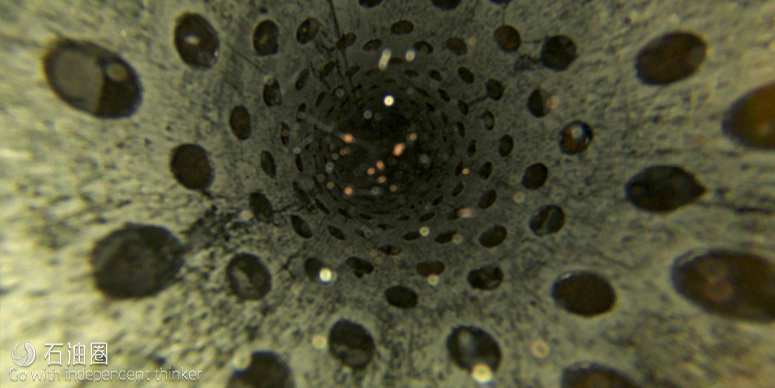
井下摄像技术实现了井筒检测的可视化,可为作业计划制定提供最为精确的数据!
编译 | 惊蛰
据报道,2020年前全球钻完井市场还将继续增长4%左右,数量巨大的新井会在2019年底投入生产。而Rystad的报告显示,2019年全球完井及干预陆地作业支出将达到790亿美元,海上作业将耗费130亿美元。
对于大多数运营商而言,井筒完整性和生产优化仍然是干预作业的关键驱动因素。 为了做出最合理、高效的决策,他们希望油气服务公司能够推出可以提高作业感官能力,并帮助了解井况的工具。这其中包括视觉、声觉信息,以及在某些情况下能够获得井筒套管、油管壁厚的能力。要想实现这样的可视化能力,摄像技术非常关键。通过电缆下入耐高温/高压摄像机,可以获得实时井下数据和图像。
目前,此类技术已经进步到了这样的水平,油气行业可以使用3D耳机识别井筒出现的故障,包括打捞作业的关键尺寸测量,射孔作业产生裂缝的尺寸以及碎片信息等。该技术的发展对于油田干预作业至关重要,它可以清楚地“观察”井筒,获得以前未知的信息。摄像机和视频技术可用于多种作业,包括套管和井筒完整性监测、井下设备检测、运行验证以及油田生产监测(包括陆地和海洋)。
根据摄像机获得的信息,作业人员能够做出更准确的决策,帮助减少停机时间,降低成本。还有非常重要的一点,摄像机提供的画面真实,作业决策的制定更快速、高效。
压裂作业中的应用
北美一家开发商在压裂作业中选择使用Expro公司的井下摄像技术,目的是最大化油藏开发潜能,防止射孔作业中遗漏油气甜点,尤其是那些只需要小规模射孔作业的井段。此次作业采用摄像机尺寸为5.5 in,识别了射孔枪产生裂缝尺寸及位置。得益于该技术,开发商避免了常规的电缆及牵引器作业,作业效率和成本都大幅降低。
在此基础上,通过使用Vision WellCAM系统和WellViewer软件,开发商知晓了哪些区域已经完成射孔,哪些井段还需二次作业。只使用了一个摄像机,利用全方位旋转记录功能,获得了全井筒的高分辨率彩色图像,井筒情况记录非常直观。 数据传输可通过内存记忆和电子在线模式完成,内存容量高达128 GB,支持24小时连续录制。
摄像机的测量精度为mm级,开发商成功发现了未被压裂砂填充的产层。此次作业共对700多个射孔进行了检测,对不同尺寸的裂缝进行了管串。得益于此,开发商对射孔作业的效果了解更加深入,后期作业就可以有针对性的制定生产效率更高的开采方案。与传统的连续油管作业相比,摄像机技术累计节约成本10万美金,减少作业时间两天。
高温井作业
井下摄像机技术还可以用于高温作业环境中,与井筒测径服务一起,作为井筒监测服务的一部分。在其中一次作业中,开发商要求在高温井中使用了常规的温度/压力测井工具,但是发生了卡钻问题,服务商无法完成测井工具的回收。此外,该井井下温度高达148 °C,作业难度极大。
假设该井的套管出现了问题,完整性受到破坏,开发商就要使用替代方案来进行井筒尺寸记录工作。Expro的井下摄像工具可耐受温度高达176°C,将其下入后确定该井套管(13 3/8in)发生了垮塌问题,导致碎屑和水泥堵塞井筒,卡主了测井工具。如果下入其他工具,非常有可能被破损套管卡主,或是加剧套管的损坏程度,甚至有可能发生再次卡钻的问题。
在摄像机的帮助下,开发商快速掌握了井筒问题,一共下钻两次解决了该问题,节约钻机时间12h。得益于套管可视化,套管中水泥和岩石碎屑轮廓清晰可见,开发商实施了最为经济的补救方案。
鉴于此次作业的收获,该开发商将井下摄像机技术列入了油田维护的常规工具中,每年对这些高温井中磨蚀性流体影响进行两次监测。通过此项维护方案,能够避免井筒完整性问题及相关维护作业,一般来讲,修井费用约为150万美元,而固井费用则高达500万美元,油田运营经济效益显著提高。
技术发展趋势
除了利用摄像机、录像机技术检测井筒,开发商还将这两种工具与测径系统结合,提供更为精确度井筒信息。CalVid就是一种测径-摄像复合工具,在井筒测量时还可获得可视化信息,使得开发商对井筒情况理解更透彻。在这些覆盖全井筒精确数据的基础上,开发商的关键生产决策针对性更强,井筒和生产完整性将得到有效保障,降低故障几率,减少干预作业时间。
井下摄像技术是Expro 与Vision iO公司共同开发的,俩家公司都希望能够进一步提高技术应用能力。其中一个方向是通过可视化技术,获得井下环境的3-D视图,使井下信息利用率最大化。随着油井干预市场的不断增长,开发商对于实时信息的获取期待非常高,他们希望利用新的技术帮助快速制定关键生产决策。摄像技术的合理利用可以帮助开发商提速决策制定过程,节省作业时间,降低运营成本,确保快速有效的提供解决方案。
With drilling and completion activity forecast to grow by a 4% compound annual growth rate until 2020 and some 72,000 wells estimated to be completed by the end of 2019, well intervention activity is set to rise. Indeed, the latest global well completion and intervention expenditure is expected to reach $79 billion for onshore and $13 billion for offshore this year, according to a November 2018 Rystad Technology Oilfield Service report.
For most operators, well integrity and production optimization remain the key drivers in the planning of well intervention activity. To help make these vital decisions, they look to the service industry to develop tools that bring sensory capabilities and assist in understanding the well conditions. This includes visual, acoustic and, in certain cases, the thickness of wellbore casings and tubing. A key enabler for visualizing this is camera technology, captured in real time or memory, using HP/HT tools deployed on wireline.
These techniques have reached a point where the industry can use 3-D headsets to visualize the well and identify the problem, including the capability to measure and gauge the size of fishing necks on stuck tools, hole sizes for perforations and the nature of debris and scales.
This technology is critically important for well intervention activity as it provides a clear understanding of the (previously unknown) wellbore. The camera and video technology can be deployed in a wide range of operations, including casing and well integrity monitoring, downhole inspection, operational verification and production monitoring for both on and offshore wells globally.
The data gathered then allow decisions to be made on location, helping reduce downtime and cost, while ensuring remediation solutions are delivered quickly and efficiently.
Fracturing applications
One of Expro’s North America clients leveraged this technology to support a recent hydraulic fracturing campaign to avoid leaving hydrocarbons stranded, particularly in zones with smaller perforations. The camera was used to identify and measure the entrance hole size while understanding the position of perforations in its 5.5-in. casing. The operator needed to deliver this in a cost- and timeefficient manner, avoiding traditional methods such as electric line with tractor or e-coil conveyance.
On this basis, a Vision WellCAM system and WellViewer software with an image measurement feature were deployed to understand which zones had received the initial fracturing treatment, while identifying areas of focus for a second fracturing operation. A single camera string visually logged the well in one seamless, high-resolution color image, harnessing the 360-degree horizontally and 180-degree vertically panand- tilt capability. This allowed complete side and downhole viewing in memory and e-line mode, supported by a large internal 128-GB storage capacity that provided 24 hours of continuous recording.
Using measurements as little as 1 mm, the operator successfully discovered oversized perforations in the areas that had received the frac sand, which resulted in erosion from flow through the perforations. The full campaign inspected more than 700 perforations, with the largest variations in perforation size being .5 in. by .9 in., .58 in by .79 in. and .26 in. by .41 in.
This allowed the client to understand the results of its perforating program better, allowing it to plan a more productive second campaign, saving more than $100,000 and about two days of rig time compared to standard coiled tubing.
Geothermal applications
Downhole video cameras also are being used for hightemperature geothermal applications, where caliper and camera services are routinely performed as part of the well surveillance program worldwide.
On one particular project in which a client required to run routine pressure and temperature logging in its geothermal well, the existing service company was unable to retrieve the logging tools. Also, the temperature of the well was more than 148 C (300 F), posing additional technical challenges.
Assuming there was a casing integrity issue in the well, the client sought an alternative solution to running gauge rings or a caliper log.
Expro was approached to deploy its high-temperature (up to 176 C [350 F]) downhole video camera, which confirmed the parted 133?8-in. casing was causing rock and cement to enter the wellbore and trapping the logging tools downhole. Running additional tools could have been potentially caught in the split casing and either damaged the casing or become deemed irretrievable.
By helping to inform decision-making, this saved 12 hours of rig time and two separate runs in the hole. Visualization of the parted casing provided detailed images of the rock and cement that entered the casing, allowing the most cost-effective remedial solution to be implemented.
The client now routinely deploys downhole video cameras within its maintenance program up to twice a year to monitor the effects of corrosive fluids in these geothermal wells. This proactive approach avoids well integrity issues and associated costly repairs, saving up to $1.5 million to repair the well or $5 million to cement the well.
New technology developments
In addition to using video and camera technology to monitor wellbore conditions, operators can use a combined camera and caliper system, providing a more accurate representation of wellbore conditions. The combined caliper and video string, CalVid, allows wellbores to be measured and visualized at the same time, giving operators a complete understanding of the wellbore. Critical decisions regarding well and production integrity can be made based on a complete and accurate assessment of the entire wellbore, minimizing separate runs and rig time.
Working in partnership with Expro’s camera services partner, Vision iO, both companies are enhancing the technical capability. One such development includes cameras that can visualize the downhole environment in a 3-D view that will enhance the information provided from down the well back to the surface.
As the well intervention market continues to grow this year and onward, and as the need to receive information in real time increases, operators are looking for innovative and advanced technology options to ensure they can make decisions quickly. Utilizing video and camera technology can help drive the decision-making process, allowing operators to save both time and costs, ensuring remediation solutions are delivered quickly and efficiently.