压裂分析服能够使压裂作业过程更加透明,有助于提高作业效率!
编译 | 惊蛰
Reveal能源服务公司推出了FracEYE压裂分析服务,加强油气行业对子母井(子井为压裂作业井,母井为其邻井)连通性这一关键问题的认知。随着油田加密井的不断发展,井间压力连通造成的压裂干扰,可显著降低母井的产量。子井的产量也会欠佳。Reveal能源服务公司的目标是明确定义压裂干扰的影响,并使作业者能够及时调整其完井设计。
该服务的基础是Reveal公司先进的压力技术,其通过测量母井的压力响应,对井间连通的类型与严重程度进行分类,同时确保子井的水力压裂作业也可正常进行。观察压力响应的时间,压缩造成的压力增加可以在数百英尺内瞬间感受到,而流体运移造成的压力增加,则可能需要几分钟至几个小时。地球物理学家与完井工程师组成的团队使用时间与地质力学原理,将观察到的压力响应分为以下四类:
- 流体的直接流通:邻井中压力迅速且大幅升高;
- 流体运移:完井作业后,邻井中压力缓慢升高;
- 不排水压缩:邻井中瞬态压力响应;
- 无信号:邻井中无明显压力变化。
德克萨斯州南部的一家油气公司担心,四口井的井平台会相互造成压裂干扰,直接影响到着陆于不同地层的两口邻井。Reveal能源服务公司团队利用FracEYE服务,发现两个着陆地层之间几乎没有垂直连通。当在同一个着陆地层进行完井作业时,母井会遭受压裂干扰与流体运移。转向剂貌似没有成功避免这些压裂干扰。该团队还分析了断层引起的大量压裂干扰。通过这些信息,作业者可以有效地了解压裂干扰的影响。
Reveal能源服务公司的首席执行官Sudhendu Kashikar表示:“由于开发加密井与压裂作业是迫切的问题,我们的目标是开发出一种快速有效的服务,使作业者可及时获得信息,用以更新下一个完井设计。我们很高兴能够加深对压裂干扰的理解。”
FracEYE压裂干扰分析服务是该公司基于压力的IMAGE Frac裂缝图的补充,其中包括五项服务,现已在美国与加拿大的8000多个水力压裂段进行了现场验证。
工作原理
当子井进行水力压裂作业时,FracEYE压裂干扰分析服务通过测量母井的压力相应,可对井间连通的类型与严重程度进行分类。有了这些信息,您可以最大限度地减少压裂干扰的影响。水力压裂作业会导致周围充满流体的多孔介质中压力增加。在流体运移与岩石压缩的共同作用下,产生了母井中观测到的压力响应。通过FracEYE服务,开发商可以决定是否或何时需要改变增产措施,将压裂干扰对母井产量的潜在不利影响降至最低。
在Montney作业的一家加拿大油气公司,正在开发D1与D2层位。该公司展现出浓厚的兴趣,想要研究子井完井作业对母井产量的影响。随后部署了FracEYE服务,来量化与分类母井的压力响应,以找出原因。通过调查发现,该井段与邻井D1井之间形成了流体直接连通,同时,还可看到流体扩散至D1井。
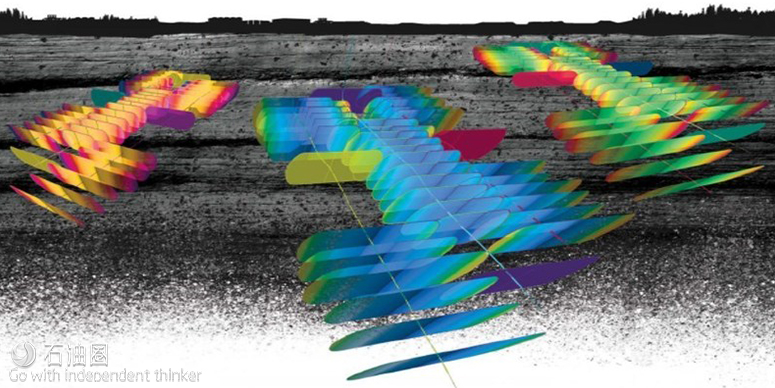
数据显示,母井与子井之间的流体连通,对两口井的跟部井段的影响越来越大。井间流体的直接连通仅限于同一层位内的井。压力响应也表明,水平段中部附近存在一些断层。当三口子井的压裂作业都影响到D1井时,3D视图可显示出不同类别的压力响应。
利用FracEYE压裂干扰分析服务,开发商可以深入了解裂缝网络所形成的层间隔离、井间连通以及有效的流体通道。对于何时改变增产措施,以将压裂干扰的影响降到最低,并将对母井产量的潜在不利影响降到最低,作业者做出了明智的、更好的决策。
Reveal Energy Services has announced the commercialization of the FracEYE frac hit analysis service to expand the industry’s knowledge base about this critical issue of parent well-child well communication.
With ongoing infill development, frac hits from the pressure communication between wells can cause significant production decreases in parent wells. Child wells can also underperform. The goal of Reveal Energy Services was to clearly define the effect of frac hits and allow operators to make timely adjustments to their completion designs.
The foundation of the service is the company’s pressure-based technology. The service categorizes the type and severity of interwell communication by measuring the pressure response from a parent well as hydraulic fracturing proceeds normally in child wells. A team of company geoscientists and completion engineers uses the pressure-response timing and geomechanics to classify the observed response into one of four categories:
- direct fluid transport: large and rapid overall pressure increase in the offset well;
- fluid migration: gradual pressure increase that lingers post-stage completion;
- undrained compression: instantaneous pressure response in the offset well; and
- no signal: no significant pressure change in the offset well.
A South Texas operator was concerned about frac hits in a four-well pad directly offsetting two parent wells stacked into separate landing zones. A Reveal Energy Services’ team, applying the FracEYE service, found there was little communication vertically between the two landing zones. There were direct frac hits and fluid migration when completing wells in the same landing zone, directly offsetting the parent well. Diverter seemed unsuccessful in mitigating these frac hits. The team also classified several major frac hits caused by faults crossing the pad. With this information, the operator had actionable insight into the effect of frac hits.
?“Because infill development and frac hits are a pressing concern, our goal was to develop a service with a fast turnaround time so operators would have the information to update their next completion designs, if necessary,” Sudhendu Kashikar, CEO of Reveal Energy Services, said. “We’re pleased that we can add to the understanding of frac hits.”
The FracEYE frac hit analysis service complements the company’s IMAGE Frac pressure-based fracture maps with five services that are now field-proven in more than 8,000 hydraulic fracturing stages in the US and Canada
How does this all work?
The new FracEYE frac hit analysis service categorizes the type and severity of interwell communication by measuring the pressure response from a parent well as hydraulic fracturing proceeds normally in child wells. With this information, you can minimize the effect of frac hits.
The creation of a hydraulic fracture results in a pressure increase in the surrounding fluid-filled porous medium. A combination of fluid migration and rock compression creates the pressure response we see in a parent well.
Looking at the timing of the pressure response, the compression forces can be felt instantaneously over hundreds of feet while the pressure increase can take minutes to hours because of fluid migration. A team of our geoscientists and completion engineers uses the timing and geomechanic principles to classify the observed pressure response into one of four categories
With the FracEYE service, you can decide if or when you need to change the stimulation treatment to minimize the effect of frac hits and the potential adverse effect on parent well production.
A Canadian operator working in the Montney, developing the D1 and D2 horizons shown in the 3D view, top left, was interested in learning how child well completions affect parent wells. We deployed our FracEYE service to quantify and categorize the induced pressure in the parent wells to find out.
The treatment data for the stage being fracked in D2-6H is shown bottom left. The induced stress on the parent wells is shown in the top-right track. We see direct fluid communication with the adjacent D2 parent well, shown by the blue curve, while we see fluid diffusion toward the D1 parent well, shown by the green curve. This analysis is supported by the temperature data, bottom right.
The data showed an increasing effect of fluid communication between the parent and the child well toward the heel of both wells. Direct fluid communication between wells is restricted to wells within the same horizon. The pressure responses also indicate some faulting near the middle of the lateral section. The 3D view shows the categorized signals while fracking the three child wells affecting the D1 parent well.
With the FracEYE frac hit analysis service, the operator had insight into zonal isolation, interwell communication, and effective fluid pathways created by the fracture network. The operator made an informed, better decision about when to change the stimulation treatment to minimize the effect of frac hits and the potential adverse effect on parent well production.